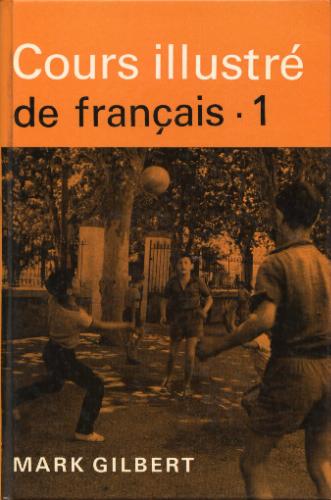
I thought I would blog about one or two of the French course books I have known over the years. Mark Gilbert's Cours Illustré de Français would look very dated now, but when it came out in 1966 (the last in the series, book 5 was published, I believe in 1973) it was rather revolutionary. This was also the time of the early audio-visual courses for slide projector and reel-to-reel tape recorder, but Gilbert's book was rooted firmly in the London University tradition of oral work through question and answer - LOTS of it. Oral and written. It was a method pioneered by Sweet, Prendergast and Gouin, a sort of controlled direct method.
Cours Illustré was the ultimate death by QA book. It was illustrated with pictures by Celia Weber, some of which were for decoration, some which could be used for questioning. It was all in glorious black and white and took a number of characters as the basis for its descriptions and stories. They did stories then!
Comedian Eddie Izzard made the book notorious with his stand-up routine about school French and Nikki the monkey (search youtube - you'll laugh). The other main characters were members of the Lavisse family. Having a family in the couse book was de rigueur in those days because it served some very useful teaching purposes. (I even wrote an essay on this topic years ago during my PGCE course at the West London Institute - part of London University.)
I reckon we would do well to return to using families in course books - never mind about politico-social sensitivities.
Anyway, each chapter of the book would feature a description or a short story and was followed with lists of questions to be exploited orally and on paper. The book was the apotheosis of this method of teaching a language: scrupulous selection and grading of language, an oral approach with little use of English, lots of whole class oral question and answer, grammar taught through repeated drilling and practice rather than by explanation in English but in a meaningful way.
As a method it had its limitations, but it worked well for pupils who could concentrate at length and induce grammar rules for themselves. I used the course from 1968 through to O level in 1973 and my memory is that the early books were the best. I recall the book still being used in my first teaching practice school, Beverley Boys, in 1980.
Amazingly I see that you can still get copies of it quite easily from used book shops on the internet. I may even be tempted to buy one!
I too learned French the hard way with this series, and while I remember nothing of my O-level exam, looking at book 5 (which I don't remember if we did), it is unbelievably hard compared to modern GCSEs (which I teach). Full scale Past Historic and Imperfect Subjunctive! 500 word reading comprehensions! Vocab from abasourdi to zèle! It's possible no teachers used this for O-level, but instead from AO or A-level study.
ReplyDeleteOn the other hand, the earlier books are still useful for teaching oral skills (question and answer is pretty good for this), and, I have found, the more challenging translation work associated with entrance exams for schools like Westminster.
And I often wonder if the ever-so-slightly exotic illustrations didn't make me appreciate French in all its différence just that little bit more...
Thanks for commenting, Richard. I'm pretty sure we didn't use Book 5 either. My recollection is that we moved away from the book after about Y10, focusing on exam-style tasks and other classroom activities.
DeleteHow I hated the famille Lavisse and Nikki the monkey!. I remember being sent out of class at my posh Surrey Girls Grammar School for commenting on how ridiculous it was that the Nikki was hoseing Mr Lavisse's car and how exactly was this going to help me if I ever went to France? Interestingly, my husband, who went to a Secondary Modern had a much more interesting book, which he thinks was called "audio visual French" or some such thing. Even after 45 + years, I've never forgotten Nikki or the Lavisse family. Who could?!!!!
ReplyDeleteIt sounds like your husband may have used Longman’s Audio-Visual French. No monkeys in that one, but no doubt some silly stories!
DeleteI was taught with the Longmans Audio visual french textbook. After a long time away from much involvement in the french language I have recently been teaching my daughter (as a result of the pandemic) using the Gilbert series. I have to say that the Gilbert books are superior on a number of points including the illustrations. I found the Longmans more than a bit dull at times and I think the same cannot be said about the Gilbert books. I'm sorry to disagree with the teenage Emma but I think that she got the better deal at her grammar school !
ReplyDeleteIt just shows how opinions vary, doesn’t it? Thank you for commenting.
Delete